Indoor Radio Network Planning:
DAS, Small Cells, and 5GPianificazione Radio Indoor:
DAS, Small Cell e 5G
More than 80% of mobile data traffic originates or terminates indoors. Yet indoor radio propagation is far more complex, unpredictable, and site-specific than outdoor propagation — and the consequences of poor indoor coverage are immediate and commercially visible: dropped calls in meeting rooms, failed video conferences in lobbies, and frustrated subscribers switching operators. Indoor radio planning is the discipline of designing systems that deliver reliable, high-capacity coverage inside buildings where the outdoor network cannot penetrate adequately.
Più dell'80% del traffico dati mobile ha origine o destinazione in ambienti chiusi. Eppure la propagazione radio indoor è molto più complessa, imprevedibile e dipendente dal sito rispetto alla propagazione outdoor — e le conseguenze di una scarsa copertura indoor sono immediate e commercialmente visibili: chiamate cadute nelle sale riunioni, videoconferenze fallite nelle lobby e abbonati frustrati che cambiano operatore. La pianificazione radio indoor è la disciplina di progettare sistemi che forniscano copertura affidabile e ad alta capacità all'interno degli edifici dove la rete outdoor non riesce a penetrare adeguatamente.
Why Indoor Coverage Is CriticalPerché la Copertura Indoor è Critica
The outdoor-to-indoor penetration problem is getting worse with every building generation. Modern energy-efficient buildings are designed with low-emissivity (Low-E) glass, metal cladding, and concrete/steel structural elements that attenuate radio signals by 15–35 dB. A 5G NR signal from an outdoor macro at 3.5 GHz loses roughly 20–30 dB passing through the façade of a modern office tower — reducing an excellent outdoor signal to marginal or unusable coverage at depth inside the building.
The business case for dedicated indoor coverage systems is straightforward: enterprise customers and high-value subscribers spend the majority of their day indoors (offices, shopping centers, hospitals, hotels). Providing excellent indoor coverage is directly correlated with subscriber retention in the enterprise and premium consumer segments.
Il problema di penetrazione dall'esterno all'interno peggiora ad ogni generazione di edifici. Gli edifici moderni ad alta efficienza energetica sono progettati con vetro a bassa emissività (Low-E), rivestimenti metallici ed elementi strutturali in cemento/acciaio che attenuano i segnali radio di 15–35 dB. Un segnale 5G NR da un macro outdoor a 3,5 GHz perde circa 20–30 dB attraversando la facciata di una moderna torre per uffici — riducendo un segnale outdoor eccellente a una copertura marginale o inutilizzabile in profondità nell'edificio.
Il caso commerciale per i sistemi di copertura indoor dedicati è chiaro: i clienti aziendali e gli abbonati di alto valore trascorrono la maggior parte della giornata in ambienti chiusi (uffici, centri commerciali, ospedali, hotel). Fornire un'eccellente copertura indoor è direttamente correlato alla fidelizzazione degli abbonati nei segmenti enterprise e consumer premium.
Indoor Radio ArchitecturesArchitetture Radio Indoor
Three primary architectures address indoor coverage, each with different cost profiles, deployment complexity, and performance characteristics:
Tre architetture primarie affrontano la copertura indoor, ciascuna con diversi profili di costo, complessità di deployment e caratteristiche di prestazione:
Distributed Antenna Systems (DAS)Sistemi di Antenne Distribuite (DAS)
DAS distributes a base station's signal through a network of passive (coaxial cable + splitters + antennas) or active (fiber + remote radio heads + antennas) components across a building. The base station — typically co-located in a basement equipment room — provides the radio interface, while the distributed antenna network brings the signal to every floor and zone.
Passive DAS (coaxial) is cost-effective for small to medium buildings but suffers from high cable loss over long runs — limiting antenna density at range. Active DAS (fiber) eliminates cable loss and supports much larger buildings (hospitals, airports, stadiums) with hundreds of antenna ports, but requires active remote units at each distribution point, increasing cost and maintenance complexity. Multi-operator DAS shares a single antenna infrastructure across multiple MNOs, reducing per-operator cost in neutral-host deployments.
Il DAS distribuisce il segnale di una stazione base attraverso una rete di componenti passivi (cavo coassiale + splitter + antenne) o attivi (fibra + remote radio head + antenne) in tutto un edificio. La stazione base — tipicamente co-locata in un locale tecnico nel seminterrato — fornisce l'interfaccia radio, mentre la rete di antenne distribuite porta il segnale a ogni piano e zona.
Il DAS passivo (coassiale) è conveniente per edifici da piccoli a medi ma soffre di elevate perdite di cavo su percorsi lunghi — limitando la densità delle antenne a distanza. Il DAS attivo (fibra) elimina le perdite di cavo e supporta edifici molto più grandi (ospedali, aeroporti, stadi) con centinaia di porte antenna, ma richiede unità remote attive in ogni punto di distribuzione, aumentando i costi e la complessità di manutenzione. Il DAS multi-operatore condivide un'unica infrastruttura di antenne tra più MNO, riducendo il costo per operatore nei deployment neutral-host.
Small Cells and FemtocellsSmall Cell e Femtocell
A small cell is a self-contained base station — integrating the radio, baseband, and antenna in a single unit — deployed indoors on ceilings or walls. Unlike DAS (which extends an outdoor macro's signal), small cells are independent radio nodes with their own cell IDs, requiring proper frequency planning and inter-cell coordination to avoid interference with neighboring small cells and the overlying outdoor macro layer.
Enterprise-grade small cells (Femto/Enterprise Pico) connect via the building's IP network to a small cell gateway (HeNB-GW for LTE, ng-eNB for 5G NSA). Deployment is straightforward — one power + Ethernet cable per unit — but the backhaul capacity and reliability of the building's IP network becomes a critical dependency. Each small cell typically covers 1,000–3,000 m² at 100–500 mW transmit power.
Una small cell è una stazione base autonoma — che integra la radio, il baseband e l'antenna in una singola unità — distribuita indoor su soffitti o pareti. A differenza del DAS (che estende il segnale di un macro outdoor), le small cell sono nodi radio indipendenti con i propri Cell ID, che richiedono una pianificazione delle frequenze adeguata e il coordinamento inter-cella per evitare interferenze con le small cell vicine e il layer macro outdoor sovrastante.
Le small cell enterprise (Femto/Enterprise Pico) si connettono tramite la rete IP dell'edificio a un small cell gateway (HeNB-GW per LTE, ng-eNB per 5G NSA). Il deployment è semplice — un cavo alimentazione + Ethernet per unità — ma la capacità e l'affidabilità del backhaul della rete IP dell'edificio diventano una dipendenza critica. Ogni small cell copre tipicamente 1.000–3.000 m² a 100–500 mW di potenza di trasmissione.
Indoor Base Stations (IBS)Stazioni Base Indoor (IBS)
An IBS (Indoor Base Station) is a full-capability base station — identical in radio functionality to an outdoor macro — installed indoors at higher power than small cells (up to 2 W per antenna port). IBS systems use dedicated fiber fronthaul to a central baseband unit and are deployed in very large venues (airports, convention centers, stadiums) where small cell coverage range is insufficient and DAS cable installation is impractical. Modern 5G IBS systems support massive MIMO (32T32R or 64T64R) indoors, enabling spatial multiplexing in high-density crowd scenarios.
Un IBS (Indoor Base Station) è una stazione base a piena capacità — identica nella funzionalità radio a un macro outdoor — installata indoor a potenza superiore alle small cell (fino a 2 W per porta antenna). I sistemi IBS utilizzano fronthaul in fibra dedicato a un'unità baseband centrale e vengono distribuiti in grandi venue (aeroporti, centri congressi, stadi) dove la portata di copertura delle small cell è insufficiente e l'installazione dei cavi DAS è impraticabile. I moderni sistemi 5G IBS supportano il massive MIMO (32T32R o 64T64R) in ambienti chiusi, abilitando il spatial multiplexing in scenari ad alta densità di utenti.
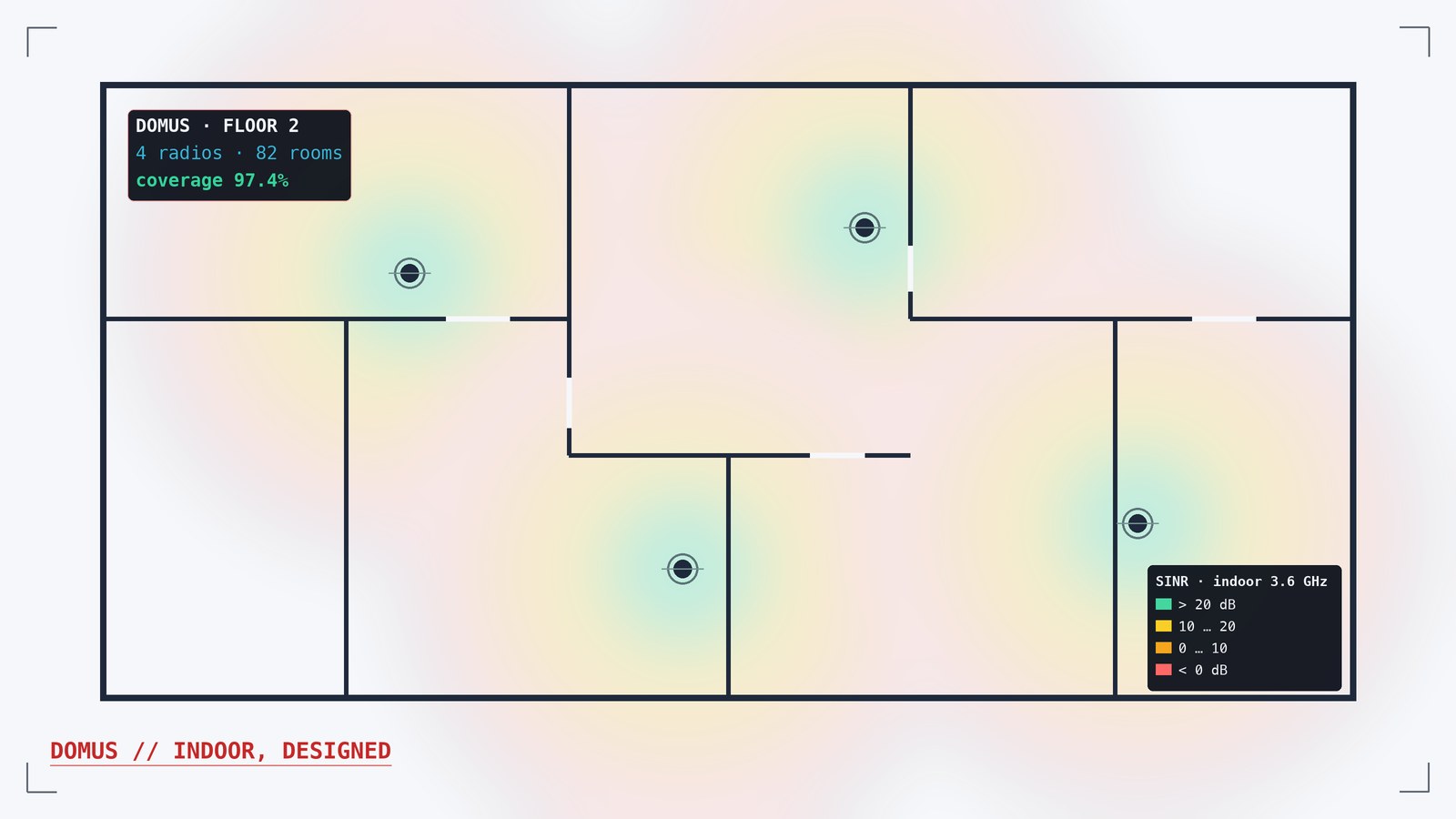
Indoor coverage floor plan showing three access points, their coverage radials, and a dead zone in the server room that needs an additional AP.Planimetria di copertura indoor che mostra tre access point, i loro raggi di copertura e una zona morta nella sala server che necessita di un AP aggiuntivo.
Indoor Propagation CharacteristicsCaratteristiche di Propagazione Indoor
Wall and Floor Penetration LossPerdita di Penetrazione di Pareti e Pavimenti
Every wall or floor between transmitter and receiver adds penetration loss on top of the distance-based path loss. The magnitude depends on the material: plasterboard partitions add 3–5 dB, brick walls 8–12 dB, reinforced concrete 15–20 dB, and Low-E glass 20–30 dB. Multi-floor loss is even higher: a concrete floor with steel reinforcement between transmitter and receiver adds 10–15 dB per floor penetrated. Indoor link budgets must explicitly account for the number and type of obstacles on the dominant propagation path.
Ogni parete o pavimento tra trasmettitore e ricevitore aggiunge perdita di penetrazione alla perdita di percorso basata sulla distanza. L'entità dipende dal materiale: le partizioni in cartongesso aggiungono 3–5 dB, i muri in mattoni 8–12 dB, il cemento armato 15–20 dB e il vetro Low-E 20–30 dB. La perdita multi-piano è ancora più alta: un pavimento in cemento con rinforzo in acciaio tra trasmettitore e ricevitore aggiunge 10–15 dB per piano penetrato. I link budget indoor devono tenere esplicitamente conto del numero e del tipo di ostacoli sul percorso di propagazione dominante.
| MaterialMateriale | Loss at 2.4 GHzPerdita a 2,4 GHz | Loss at 3.5 GHzPerdita a 3,5 GHz |
|---|---|---|
| Plasterboard / drywallCartongesso / pannello secco | 3–5 dB | 4–6 dB |
| Wooden interior doorPorta interna in legno | 4–6 dB | 5–7 dB |
| Brick wall (hollow)Muro in mattoni (forato) | 6–10 dB | 8–12 dB |
| Concrete wall (solid)Muro in cemento (pieno) | 12–18 dB | 15–22 dB |
| Reinforced concrete floorSolaio in cemento armato | 10–15 dB | 12–18 dB |
| Low-E glass (modern)Vetro Low-E (moderno) | 20–28 dB | 25–35 dB |
Multi-path and ReflectionsMulti-percorso e Riflessioni
Inside buildings, the propagation environment is rich in reflections and diffraction paths from walls, furniture, and equipment. Unlike outdoor propagation where the line-of-sight path dominates, indoor propagation is often dominated by reflected and diffracted paths — particularly in long corridors (waveguide effect, path loss exponent ~1.7) and around corners (diffraction-dominated). This multi-path richness also enables spatial multiplexing in MIMO systems — indoor 5G MIMO typically achieves better spatial multiplexing gain than outdoor because the diverse scattering environment creates well-separated spatial channels.
All'interno degli edifici, l'ambiente di propagazione è ricco di percorsi di riflessione e diffrazione da pareti, mobili e attrezzature. A differenza della propagazione outdoor dove domina il percorso line-of-sight, la propagazione indoor è spesso dominata da percorsi riflessi e diffratti — in particolare nei corridoi lunghi (effetto waveguide, esponente di perdita di percorso ~1,7) e intorno agli angoli (dominati dalla diffrazione). Questa ricchezza multi-percorso abilita anche il spatial multiplexing nei sistemi MIMO — il MIMO 5G indoor raggiunge tipicamente un guadagno di spatial multiplexing migliore dell'outdoor perché l'ambiente di scattering diversificato crea canali spaziali ben separati.
Indoor Link BudgetLink Budget Indoor
An indoor link budget extends the standard terrestrial link budget with additional loss terms specific to the indoor environment. The key additions: floor penetration loss (if the transmitter is on a different floor), wall penetration loss (per material type and count), indoor shadowing margin (typically 5–8 dB for 95% indoor location probability — lower than outdoor because the environment is more predictable).
Un link budget indoor estende il link budget terrestre standard con termini di perdita aggiuntivi specifici per l'ambiente indoor. Le aggiunte chiave: perdita di penetrazione del solaio (se il trasmettitore è su un piano diverso), perdita di penetrazione della parete (per tipo di materiale e numero), margine di shadowing indoor (tipicamente 5–8 dB per una probabilità di posizione indoor del 95% — inferiore all'outdoor perché l'ambiente è più prevedibile).
Link budget structure. For indoor planning, Building Penetration Loss is replaced by Wall/Floor Penetration Loss terms specific to the path to each coverage zone.Struttura del link budget. Per la pianificazione indoor, la Perdita di Penetrazione dell'Edificio è sostituita dai termini di Perdita di Penetrazione di Parete/Solaio specifici per il percorso verso ogni zona di copertura.
Indoor link budgets drive antenna density decisions: given a target RSRP at the worst-case coverage point (typically the center of the most distant room on the most attenuated path), the maximum allowable path loss determines the maximum antenna spacing. In a typical office environment at 3.5 GHz, antennas must be spaced no more than 15–20 m apart to maintain −90 dBm RSRP with 95% location probability.
I link budget indoor guidano le decisioni sulla densità delle antenne: dato un RSRP target nel punto di copertura peggiore (tipicamente il centro della stanza più lontana sul percorso più attenuato), la perdita di percorso massima consentita determina la spaziatura massima delle antenne. In un tipico ambiente per uffici a 3,5 GHz, le antenne devono essere distanziate al massimo di 15–20 m per mantenere −90 dBm RSRP con probabilità di posizione del 95%.
Indoor Planning MethodologyMetodologia di Pianificazione Indoor
A structured indoor planning project follows a defined sequence:
Un progetto di pianificazione indoor strutturato segue una sequenza definita:
1. Site Survey1. Sopralluogo del Sito
Physical inspection of the building: floor plan acquisition (CAD or measured), material identification (wall types, floor construction), existing infrastructure audit (cable runs, equipment rooms, power availability), and candidate antenna locations. A site survey that skips material characterization will produce a plan that is unreliable regardless of how good the planning software is.Ispezione fisica dell'edificio: acquisizione della planimetria (CAD o misurata), identificazione dei materiali (tipi di pareti, costruzione del solaio), audit dell'infrastruttura esistente (percorsi cavi, locali tecnici, disponibilità di energia) e posizioni candidate per le antenne. Un sopralluogo che salta la caratterizzazione dei materiali produrrà un piano inaffidabile indipendentemente dalla qualità del software di pianificazione.
2. Coverage Dimensioning2. Dimensionamento della Copertura
Translate coverage requirements into antenna density: target RSRP at coverage edge → maximum path loss from antenna to coverage edge → maximum antenna spacing given the building's propagation characteristics → antenna count and placement. Dimension each floor independently; atypical floors (basement car parks, roof terraces, glass-walled conference rooms) need individual analysis.Tradurre i requisiti di copertura in densità di antenne: RSRP target al bordo della copertura → perdita di percorso massima dall'antenna al bordo della copertura → spaziatura massima delle antenne date le caratteristiche di propagazione dell'edificio → numero e posizionamento delle antenne. Dimensionare ogni piano indipendentemente; i piani atipici (parcheggi interrati, terrazze sul tetto, sale conferenze con pareti in vetro) necessitano di analisi individuali.
3. Frequency and Interference Planning3. Pianificazione delle Frequenze e delle Interferenze
For multi-operator DAS: plan the frequency allocation to avoid co-channel interference between the DAS and the outdoor macro layer at the building perimeter. For small cell deployments: configure neighbor lists and handover parameters so UEs smoothly transition between indoor small cells and outdoor macros as they enter/exit the building.Per il DAS multi-operatore: pianificare l'allocazione delle frequenze per evitare l'interferenza co-canale tra il DAS e il layer macro outdoor al perimetro dell'edificio. Per i deployment di small cell: configurare le neighbor list e i parametri di handover in modo che gli UE effettuino una transizione fluida tra le small cell indoor e i macro outdoor all'ingresso/uscita dall'edificio.
4. Walk Test Validation4. Validazione con Walk Test
After commissioning, systematic walk testing on each floor confirms that measured coverage matches the plan. Walk tests typically use 100ms measurement sampling via floor-by-floor grid patterns. Post-processing compares measured vs predicted RSRP; areas with >8 dB error trigger re-analysis and antenna repositioning or power adjustment.Dopo la messa in servizio, il walk test sistematico su ogni piano conferma che la copertura misurata corrisponda al piano. I walk test utilizzano tipicamente un campionamento delle misurazioni di 100ms tramite pattern a griglia piano per piano. Il post-processing confronta RSRP misurato vs previsto; le aree con errore >8 dB attivano una nuova analisi e il riposizionamento dell'antenna o la regolazione della potenza.
5G Indoors: Challenges and Opportunities5G Indoor: Sfide e Opportunità
5G NR at FR1 (3.5 GHz) faces more severe indoor propagation challenges than LTE at 1800 MHz: path loss at 3.5 GHz is 6 dB higher than at 1800 MHz at the same distance, and penetration loss through modern building materials is 5–10 dB higher. This means 5G indoor systems require higher antenna density than equivalent LTE systems — roughly 1.5–2× more antenna points for the same coverage quality.
The 5G advantage indoors comes from capacity rather than coverage: 5G NR's wider spectrum bandwidths (100 MHz at 3.5 GHz vs 20 MHz for LTE), spatial multiplexing gains from MIMO, and network slicing for enterprise use cases (URLLC for manufacturing automation, eMBB for AR/VR) create a compelling case for dedicated indoor 5G investment in high-value enterprise buildings. A single 5G IBS sector with 64T64R serving a 2,000 m² open-plan office can provide multi-Gbps aggregate throughput to hundreds of simultaneous users.
Il 5G NR in FR1 (3,5 GHz) affronta sfide di propagazione indoor più severe rispetto all'LTE a 1800 MHz: la perdita di percorso a 3,5 GHz è 6 dB superiore a quella a 1800 MHz alla stessa distanza, e la perdita di penetrazione attraverso i materiali edilizi moderni è 5–10 dB superiore. Ciò significa che i sistemi 5G indoor richiedono una densità di antenne superiore rispetto ai sistemi LTE equivalenti — circa 1,5–2× più punti antenna per la stessa qualità di copertura.
Il vantaggio del 5G indoor proviene dalla capacità piuttosto che dalla copertura: le larghezze di banda spettrale più ampie del 5G NR (100 MHz a 3,5 GHz vs 20 MHz per LTE), i guadagni di spatial multiplexing dal MIMO e il network slicing per casi d'uso enterprise (URLLC per l'automazione manifatturiera, eMBB per AR/VR) creano un caso convincente per investimenti 5G indoor dedicati negli edifici enterprise di alto valore. Un singolo settore IBS 5G con 64T64R che serve un open-space da 2.000 m² può fornire un throughput aggregato multi-Gbps a centinaia di utenti simultanei.
mmWave indoors: 5G FR2 (mmWave, 26/28/39 GHz) has extremely high path loss but enables multi-Gbps per-user throughput for short-range applications. A single mmWave small cell covering a 20m × 20m conference room can deliver 10+ Gbps aggregate capacity — sufficient for holographic conferencing, industrial VR, and high-density AR applications that FR1 cannot support.
mmWave indoor: Il 5G FR2 (mmWave, 26/28/39 GHz) ha una perdita di percorso estremamente elevata ma abilita throughput per utente multi-Gbps per applicazioni a corto raggio. Una singola small cell mmWave che copre una sala conferenze 20m × 20m può fornire più di 10 Gbps di capacità aggregata — sufficiente per la conferenza olografica, la VR industriale e le applicazioni AR ad alta densità che FR1 non può supportare.
NEXT Fusion Indoor PlanningPianificazione Indoor con NEXT Fusion
NEXT Fusion supports indoor planning through floor plan import (CAD DXF, GeoTIFF, PDF raster), per-room material assignment (wall types, floor types), and indoor propagation modeling using empirical multi-wall models (modified COST 231 Multi-Wall) or ray-tracing-based models for complex geometries. Antenna placement is optimized iteratively: the planner positions antennas manually on the floor plan, runs the coverage calculation, and adjusts until all coverage targets are met.
NEXT Fusion supporta la pianificazione indoor tramite l'importazione di planimetrie (CAD DXF, GeoTIFF, PDF raster), l'assegnazione del materiale per stanza (tipi di pareti, tipi di pavimenti) e la modellazione della propagazione indoor usando modelli multi-parete empirici (COST 231 Multi-Wall modificato) o modelli ray-tracing per geometrie complesse. Il posizionamento delle antenne viene ottimizzato in modo iterativo: il pianificatore posiziona le antenne manualmente sulla planimetria, esegue il calcolo della copertura e regola fino a quando tutti gli obiettivi di copertura sono soddisfatti.
Floor Plan ImportImportazione Planimetria
DXF, GeoTIFF, or PDF floor plans — each room and wall typed by material.Planimetrie DXF, GeoTIFF o PDF — ogni stanza e parete classificata per materiale.
Multi-Wall ModelModello Multi-Parete
Per-wall penetration loss computation for accurate indoor path loss estimates.Calcolo della perdita di penetrazione per parete per stime accurate della perdita di percorso indoor.
Walk Test OverlayOverlay Walk Test
Import walk test measurements and compare against indoor predictions floor by floor.Importa le misurazioni del walk test e confrontale con le previsioni indoor piano per piano.